

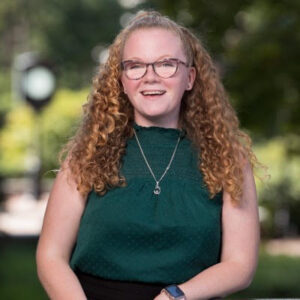
Name: Siobhan Kiernan
Class Year: 2021
Title: Leadership Annual Giving Officer
Organization: Holy Cross
1. In one sentence, what does your job entail?
I connect with alumni, families, and friends of the College to build meaningful relationships and align their philanthropic interests with opportunities that support Holy Cross and its students.
2. What planned and unplanned events connected you to your industry and your first employer after Holy Cross? How did you learn/decide it was a good fit for you?
As a first-generation college student majoring in economics, I fully planned to work in finance. I hadn’t fleshed out where in Finance, but all sights were set on Wall St., and if that failed, I’d go teach Math. Then came my junior year and with it, the COVID-19 pandemic, forcing me to spend a great deal of time, like many others, online and with my thoughts. I decided then that I would never want to teach online, and that life was too short to be spent going through spreadsheets. It was during this period that Prof. Boyle, from the economics department, encouraged me to discern more, and asked if I had ever thought about development. I hadn’t, but after some research and informal conversations with the HC Advancement team, I felt pulled in this direction.
3. What were you involved in when you were on campus?
I sang in the College Choir, Chapel Choir, and Off the Record. I was also a tutor in the Economics Department and a Campion Cookie Baker.
4. What was your major and how did it affect your career decisions?
Economics! Economics is the study of how people act/behave with limited resources (money, time, etc.) to maximize enjoyment. In my role, I am assisting individuals who are interested in financially supporting Holy Cross, who have limited resources…It’s funny—I wouldn’t say that studying economics necessarily shaped or affected my career path. Rather, it was my experience within the department and the relationships I built that had the greatest impact. One economics professor, in particular, encouraged me to pursue a career in development, and my experience at Holy Cross was so meaningful that fundraising for this place feels like second nature.
5. What are one or two skills that you developed at Holy Cross that you use in your work?
Time management and comprehensive problem-solving. Holy Cross is incredibly rigorous, so if you want to take advantage of all you can in your 4 years and stay above ground academically, you’ve got to learn how to juggle a variety of priorities. This is definitely still the case now, especially when you are managing a range of expectations, deadlines, donors, etc. Additionally, the ability to think creatively and comprehensively about obstacles is incredibly useful. Going to a Liberal Arts school and taking courses across an assortment of disciplines simply prepares you to ask questions and think holistically when faced with a problem. Sometimes I analyze an obstacle like an economist, considering incentives and outcomes; other times I approach it like a historian, looking for context and patterns. The ability to think differently has been invaluable in navigating challenges and developing solutions.
6. What advice do you have for students on campus today?
Make the most of your time! Four years feel like a long while, but it’ll go by before you know it. You’re in a community surrounded by some incredibly impressive peers. It’s a period of time unlike any other, so take advantage of all that you can. And with that, try new things and embrace your mistakes (they are definitely not that deep).
7. What are your thoughts on how AI has impacted or will impact your industry? What advice do you have for students as they prepare to enter a professional world where AI is prevalent?
I have a strong belief that our work is very people-centric. Philanthropy is incredibly emotional; sometimes those decisions involve children, parents, etc. I am proud to work with the alumni I do, know their stories, passions… and I don’t think AI can simply replace that. Now, do I think AI can help in alleviating some administrative tasks? Absolutely! I think of it as a tool to save time, but when I meet with a donor, its person to person.